If you are an architect (solution, technical, martech), IT leader in your organization in charge of your marketing stack, wondering about Salesforce connections, it is hard to understand how to take the 2-day event to your organization and present your findings from a big-picture perspective. While it is easy to focus on cool features like marketing cloud next, RCA, etc, the question your leadership will ask is the following.
- What do Salesforce Connections sessions help our organization with from a roadmap perspective?
- When and why should I even consider data cloud?
- What capabilities can we empower our marketers to generate more leads and opportunities?
My blog will help you understand the big picture and the questions above. As I attended Salesforce Connections 2026, one theme stood out above everything else: AI agents are becoming part of the marketing workforce. Throughout the sessions, Salesforce showcased Agentforce Marketing, autonomous agents, conversational experiences, and a future where marketers increasingly work alongside agents rather than simply using software tools. While many attendees focused on the new features, I found myself looking at the bigger architectural picture. What became clear to me is that Salesforce is introducing a new architectural pattern for marketing—one that centers on context, agency, and conversations.
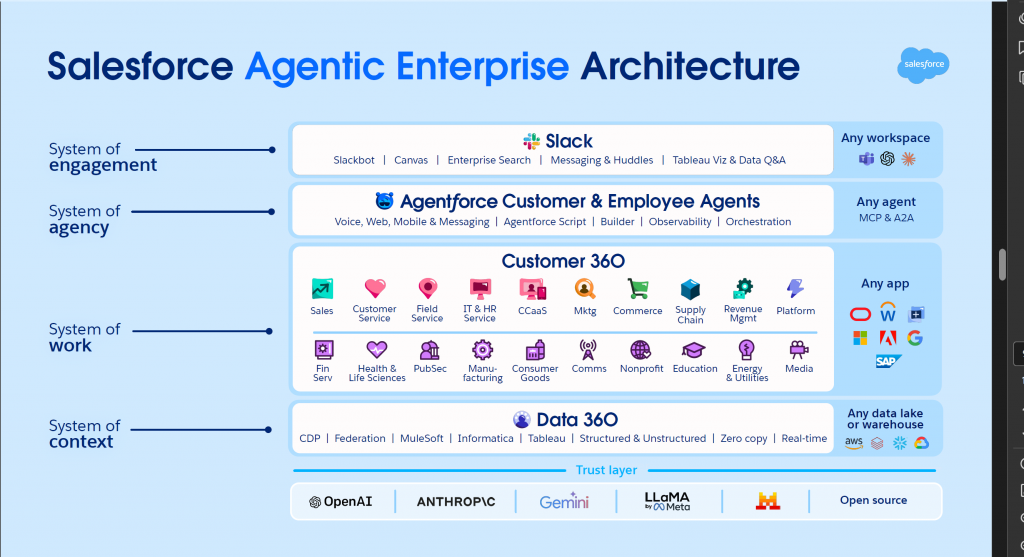
Caption: Salesforce’s Agentic Enterprise Architecture illustrates how context, work, agency, and engagement converge to enable AI-powered business operations.
The architecture slide shown during Connections was one of the most important visuals I saw all week. It described an Agentic Enterprise Architecture built on four layers: the System of Context, the System of Work, the System of Agency, and the System of Engagement. At the foundation sits Data Cloud and enterprise data. Above it are business applications where work gets done. On top of that are agents capable of reasoning and taking actions. Finally, engagement happens through channels such as Slack, messaging, voice, mobile, and web experiences. When I looked at the announcements through this lens, three architectural shifts became clear.
Shift #1: Data Cloud Is Becoming a System of Context
One of the biggest misconceptions I continue to hear from architects and IT leaders is that Data Cloud is simply another data warehouse. The question often becomes, “Why would I build another warehouse when I already have one?” My perspective is that Data Cloud’s greatest value lies in unstructured data. Most organizations already have a strategy for structured transactional data through warehouses and data lakes.
The real opportunity is contextual data. If a marketing team wants to understand customer intent, buying signals, interests, and engagement patterns, that information is often hidden in places traditional warehouses were never designed to handle. Product manuals, meeting transcripts, call notes, email summaries, PowerPoint presentations, and other forms of unstructured data are becoming critical sources of context. Agents can analyze these sources and uncover signals that would be impossible to identify with traditional segmentation models.
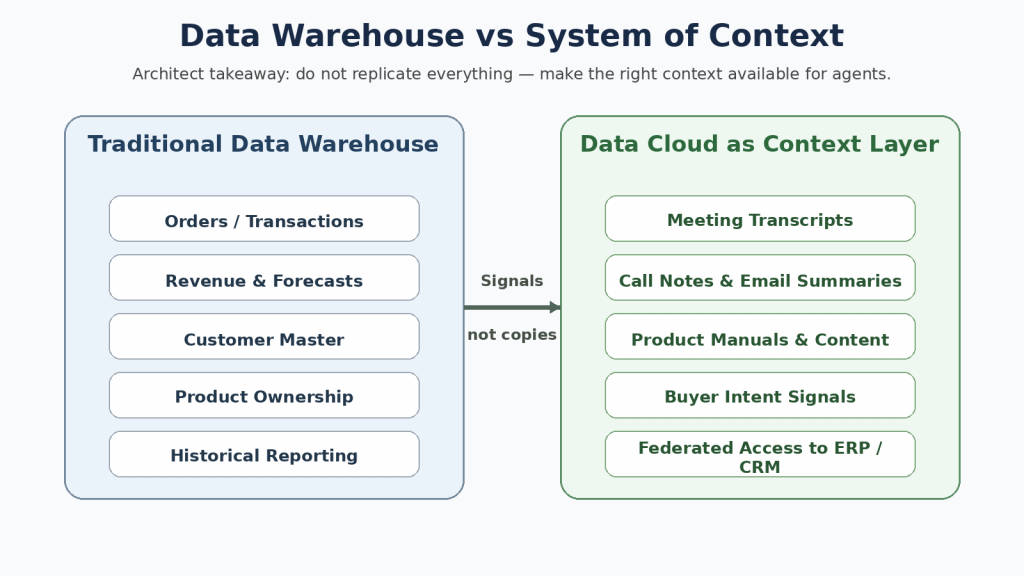
Caption: The future is not about copying every record into Data Cloud. It is about making the right structured and unstructured context available for agents.
This does not mean every piece of enterprise data belongs inside Data Cloud. I believe architects should take a use-case-driven approach. If a marketing use case requires specific signals or intent data, then make that data available. In many cases, summaries and contextual information are more valuable than moving every transaction into Data Cloud. The future architecture is likely to be federated, with Data Cloud providing context and reaching into ERP, CRM, data warehouses, and other systems when additional information is needed. Here are 3 key questions you should ask before you evaluate what data belongs to data cloud?
- Does the data help your current salesforce crm users (sales, service, marketing) to do their job proactively ?
- If I have unstructured data like files, PDFs, and do have an enterprise vector database as a solution, how would the unstructured data help my marketing team identify signals from customers or prospects on buying and decision-making?
- Will the data help my Salesforce crm users to identify the intent of the customers and prospects related to buying, customer service issues, etc?
Shift #2: Marketing Is Moving from Automation to Agency
For years, marketing automation focused on designing journeys, defining rules, and scheduling campaigns. Humans decided what should happen, and software executed those instructions. Agentforce introduces a fundamentally different model.
The simplest analogy I can think of is cleaning a house. Traditional marketing automation is like manually operating a vacuum cleaner. You decide where to clean, when to clean, and how much effort to apply. Marketing agents are more like robot vacuum cleaners. They can independently clean multiple rooms while you supervise outcomes and exceptions. Both approaches accomplish the work, but the management models are completely different.
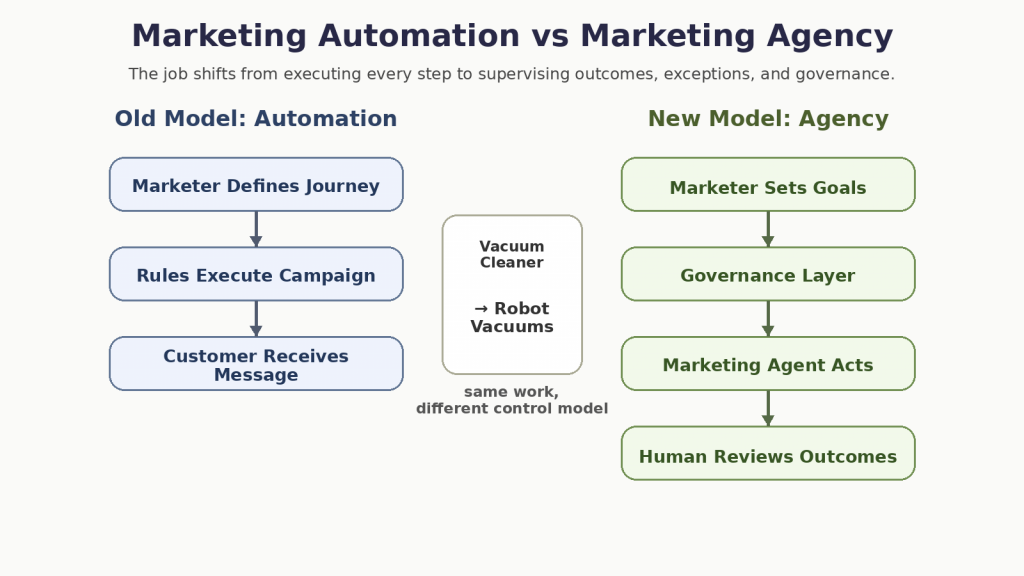
Caption: The architect’s job moves from designing every step of execution to governing agent decisions, exceptions, and outcomes.
As agents become capable of making recommendations, generating content, creating audiences, and optimizing outcomes, governance becomes more important than automation itself. My biggest concern is not whether agents can perform the work. My concern is whether organizations are prepared to govern them. Sensitive data, compliance requirements, and security constraints must be incorporated into an agent’s operating model. Every organization should identify sensitive data, define approval processes, and establish a security framework that balances context with human oversight. In my view, agent governance should be a shared responsibility between IT and Marketing, with Marketing ultimately owning the business outcomes.
Shift #3: Marketing Is Evolving from Campaigns to Conversations
Another trend that became impossible to ignore was the shift toward conversational engagement. Features such as RCS messaging, Agentforce Voice, conversational search, and interactive experiences all point toward a future where marketing is no longer limited to one-way communication.
Historically, marketers pushed emails, messages, and campaigns to customers. The customer consumed the information and responded through separate channels. In the future, those interactions become conversations. Customers will ask questions, seek clarification, negotiate options, and request information in real time. More importantly, those conversations may not always be with humans.
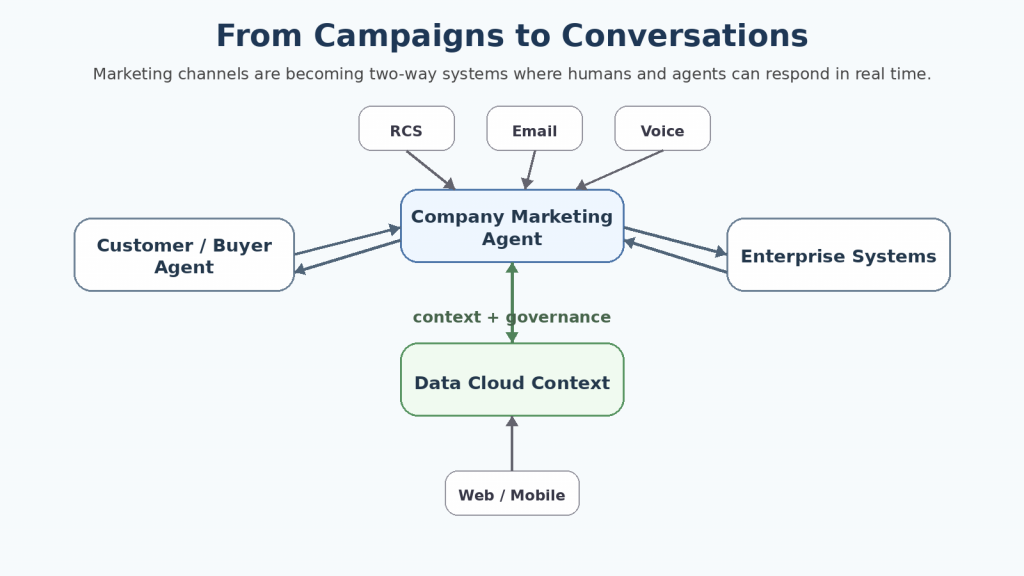
Caption: Marketing channels are becoming two-way systems where humans and agents can respond in real time.
I believe we are approaching a world where organizations will increasingly interact with customer agents as much as with customers themselves. Imagine a manufacturer sending information about a product release. Instead of a human buyer reading the email, a procurement agent may review the content, ask follow-up questions, compare pricing, analyze specifications, and return recommendations to the buyer. Similar scenarios will emerge in higher education, healthcare, public sector, and financial services. Parents, students, patients, and citizens may all rely on agents to gather information and make decisions on their behalf.
This creates a new architectural challenge: designing for agent-to-agent interactions. Organizations must prepare agents with context, governance, security, and access to the right information so they can both ask and answer questions effectively.
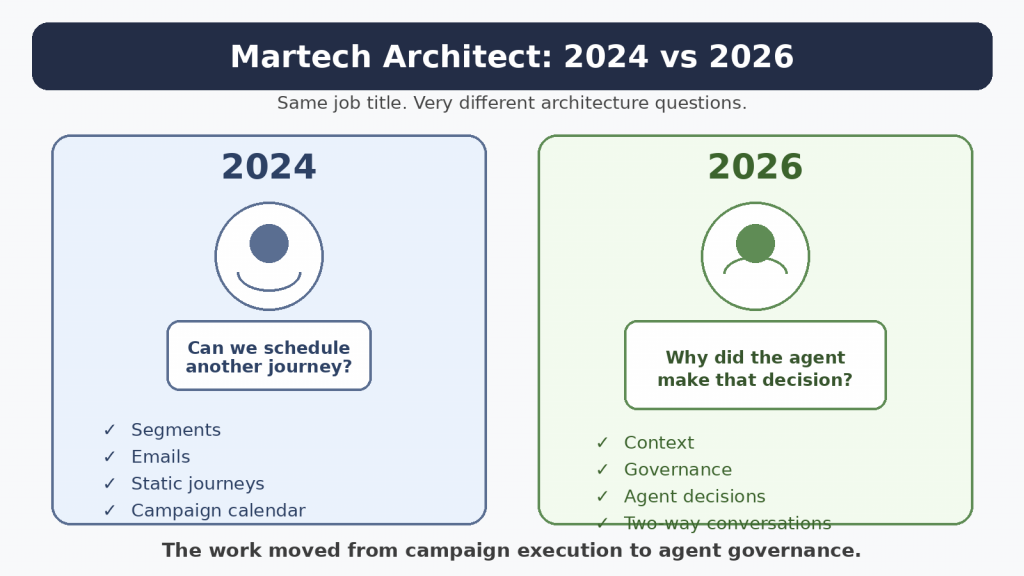
Caption: A simple mental model for architects after Salesforce Connections 2026.
Final Thoughts
The biggest takeaway I brought home from Salesforce Connections 2026 is that Salesforce is not simply adding AI to Marketing Cloud. They are building a platform designed for a future where agents become active participants in marketing operations. The combination of Data Cloud, Agentforce, conversational channels, and governance capabilities creates the foundation for what I would call an Agentic Martech Architecture.
The biggest mistake Martech Architects will make over the next three years is continuing to optimize for a static marketing model built around campaigns, emails, and messages while ignoring the need for contextual data and agent readiness. Organizations that prepare for agents today will have a significant advantage as customer interactions become increasingly conversational and autonomous. The question is no longer whether agents will become part of marketing. The question is whether our architecture is ready for them.
To summarize, here are 3 key takeaways for you as an architect, IT leader, or business leader if you are using the marketing cloud stack.
- Start creating a data strategy for unstructured data around your organization, which can help marketers with intent and signals.
- If your marketing team wants to leverage marketing agents to increase productivity, identify use cases and prepare for marketing cloud next.
- Identify agents that would help in 2 way conversations, which can support RCA, website, and others.
You are always welcome to post your comments and feel free to email me at buyan@eigenx.com for further questions.