You know that meme where the dog is sitting at a desk, the entire office is on fire, and he calmly says “This is fine”? That was marketing operations before AI Agents. Subject lines drafted at midnight. Campaign briefs bouncing between four people. Performance reports nobody had time to pull. And somewhere in the middle of the chaos, someone asking, “Why isn’t the campaign live yet?”
Well, what if I told you someone put down that coffee cup, walked out of the burning room, and handed the work to an AI Agent instead?
Welcome back to SforceMaximizer, where we help you Do More, Prevent Problems, and Make Better Decisions with your Salesforce investment.
Today’s post is one of my favorites — because it’s not theory. It’s a real-world conversation with someone who has actually built this stuff, learned from it, and is generous enough to share the unfiltered truth.
I had the pleasure of sitting down with Charmy Gajera, an Associate Director – Marketing at BugendaiTech, 12x Marketing Certified Professional, and titled as a Salesforce Marketing Cloud Champion, who is doing seriously impressive work at the intersection of Marketing Operations, Data Cloud, and Agentforce. Whether you’re a Salesforce Admin trying to reduce manual campaign work, an Architect evaluating Marketing Cloud Growth + Data Cloud, or an IT leader wondering if Agentforce is actually ready for real marketing use cases — this one’s for you.
Let’s get into it. 👇
Q1: Can you share one or two use cases on how you implemented AI Agents for marketing, and how it helped reduce time or increase productivity?
Charmy: In our marketing operations, we implemented AI Agents to remove bottlenecks in the execution and reporting of campaigns.
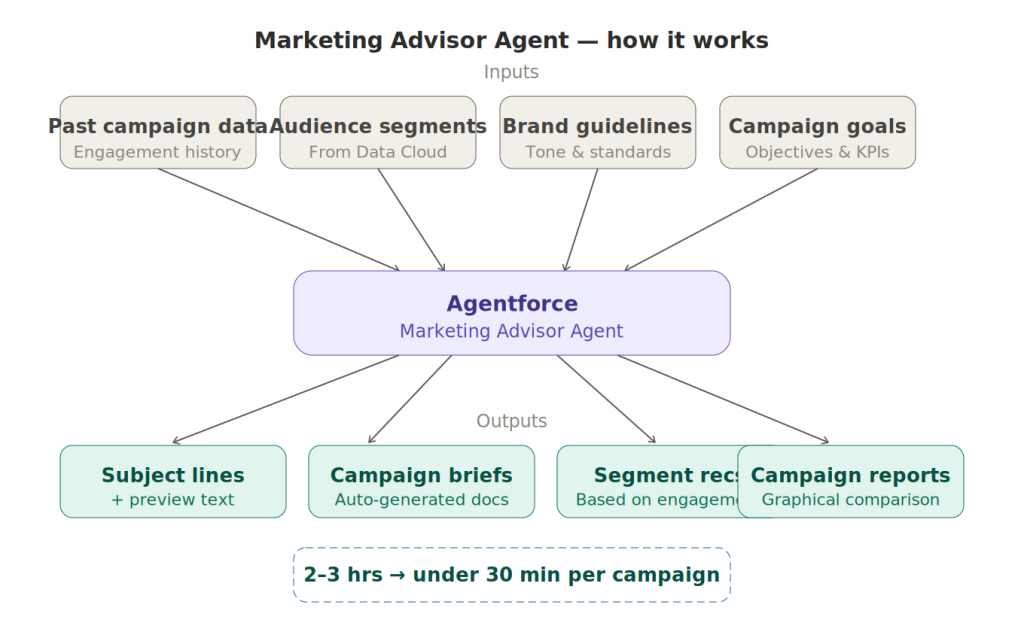
Use Case 1: The Marketing Advisor Agent
We used an Agent to support the marketing team with:
- Drafting email subject lines and preview text
- Creating campaign briefs and documentation
- Recommending audience segments based on past engagement
- Campaign comparison in graphical format — like a live report
Impact: This reduced campaign preparation time from 2–3 hours to under 30 minutes per campaign. The team could focus more on strategy and creativity instead of repetitive tasks. Along with that, the team can now identify the best-performing campaign within a minute.

Q2: What were the lessons learned — the pros, cons, and considerations for implementing Agents?
Charmy: Implementing Agents taught us that success depends more on process readiness and team adoption than just technology. Training, continuous learning, and R&D played a very important role here.
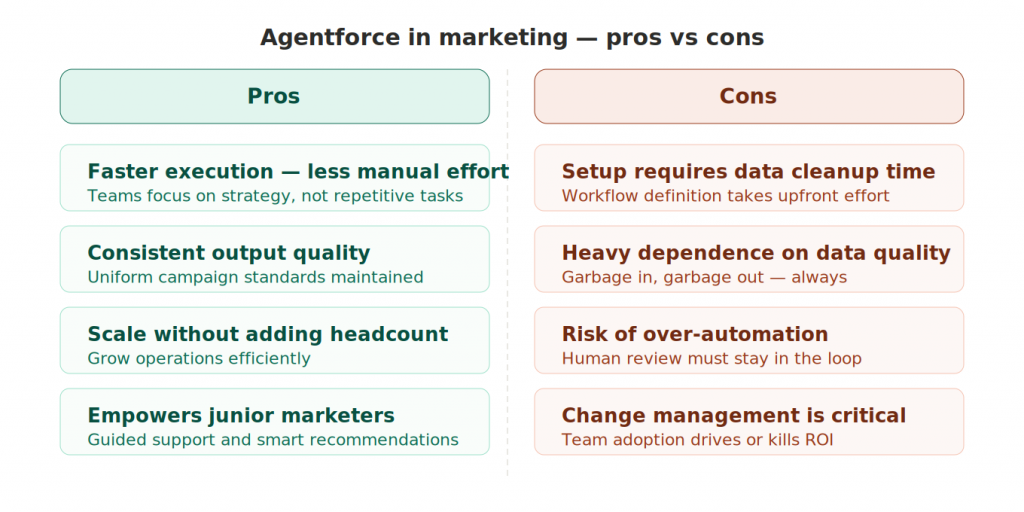
The Pros
The biggest advantage is improved execution speed — reducing manual effort so teams can focus on strategy and creativity. Consistency in output quality increased too, ensuring campaigns maintain a strong, uniform standard. Agents also make it very easy to scale marketing operations without immediately expanding headcount. Perhaps most importantly, they empowered junior marketers to perform at a higher level by providing guided support, best practices, and intelligent recommendations in their day-to-day work.
The Cons
- Initial setup requires time for data cleanup and workflow definition
- Agents depend heavily on data quality — maintaining the data is critical
- Risk of over-automation, especially when human review of performance is ignored
Key Lessons & Considerations
- Always start with 1–2 high-impact use cases instead of automating everything
- After my 2nd Agent build, my biggest lesson: keep humans in the loop for approvals and brand tone
- Train the team early to avoid resistance
- Define clear success metrics — time saved, productivity gained, campaign speed. Consistent surveys helped a lot here.
Q3: You used Salesforce marketing products and Data Cloud — can you share features, best practices, pros, and cons?
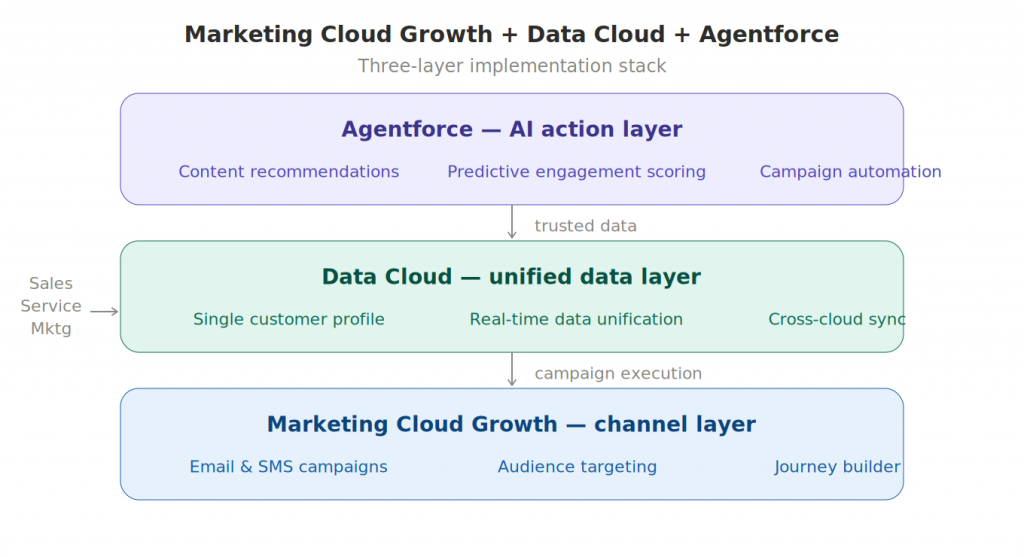
Charmy: Yes, our implementation was built using Salesforce Marketing Cloud Growth, Data Cloud, and Agentforce.
Key Features Used
Data Cloud Unification:
- Created a single customer profile across Sales, Service, and Marketing
- Enabled Agents to work with trusted, real-time data
Einstein & Agentforce:
- AI-driven content recommendations
- Predictive engagement scoring
- Agent-based automation for campaign setup and reporting
Best Practices
- Clean and normalize data before introducing Agents
- Define guardrails for what the Agent can and cannot do
- Keep prompts simple and business-focused
- Test thoroughly in sandbox before production rollout
One of the biggest advantages of using Salesforce-based AI Agents is their deep integration with the broader Salesforce ecosystem — marketing, sales, and service teams work seamlessly with shared data and workflows. The platform also offers enterprise-grade security and strong governance for organizations that prioritize compliance and data protection.
However, successful implementation requires a solid foundation of clean data and well-defined processes. Change management is equally critical, and organizations should clearly track ROI to ensure AI investments are delivering measurable business impact.
Q4: Can you share any screenshots or visuals relevant to your project?
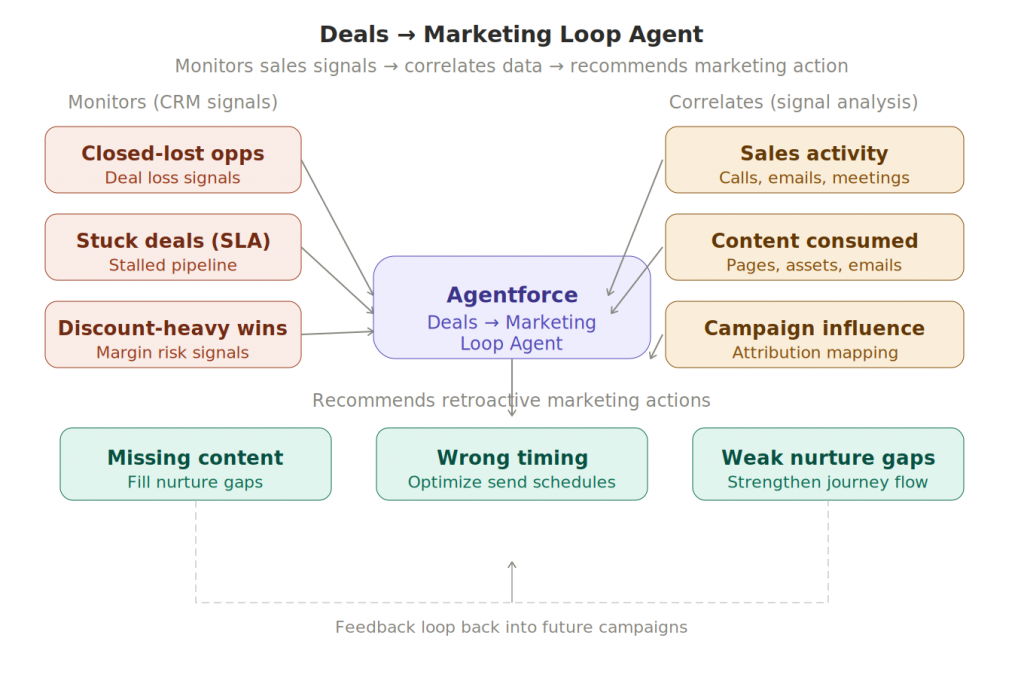
Charmy: Sure! While this Agent is still under development 🔧, let me explain what the Deals → Marketing Loop Agent does at a high level.
It monitors:
- Closed-lost opportunities
- Deals stuck beyond SLA
- Discount-heavy wins
It correlates:
- Sales activity
- Content consumed by prospects
- Campaign influence on deals
It recommends retroactive marketing actions:
- Missing content gaps
- Wrong timing issues
- Weak nurture gaps in the journey
Q5: What habits have helped you build your personal brand and elevate your career?
Charmy: Here are the two habits that have played a major role in shaping my personal brand and career growth:
1. Sharing knowledge consistently. I consistently share learnings, experiments, and real-world use cases through blogs, internal sessions, and social platforms. This helped me build credibility and visibility.
2. Being the bridge between business and technology. I invested time in understanding both marketing strategy and Salesforce architecture. This positioned me as someone who can translate business needs into scalable tech solutions.
These habits helped me stand out — not just as a Marketer, but as a growth enabler and problem solver.
Q6: What does the word “proactive” mean to you, and can you share where you’ve implemented it?
Charmy: To me, being proactive means anticipating challenges and acting before they become problems.
Experience 1 — With My Internal Team: I noticed campaign delays due to dependencies on multiple teams and departments. Before it became a leadership issue, I proposed using automation tools, AI tools, and pre-built AI Agents to automate pre-campaign checks, data quality, and approvals.
Result: Campaign turnaround time reduced by 30%.
Experience 2 — With Client Engagement (As I am a techno-functional girl 😊): For a client, I saw early signs of declining engagement in campaign metrics. Instead of waiting for the review cycle, I proactively created an AI-powered insights report with a dashboard and shared some optimization ideas.
This shifted the conversation from reactive support to strategic partnership.
“For me, proactiveness is not about doing more work — it’s about doing the right work at the right time.”— Charmy Gajera, Salesforce Marketing Cloud Champion
Closing Thoughts
Charmy’s journey is a masterclass in what it actually looks like to implement AI Agents in the real world — messy data and all. No fluff, no “just click this button and the AI does everything.” Just honest, hard-won experience from someone who’s been in the trenches and come out with real results.
If there’s one thing that stood out in this conversation, it’s this: Agentforce isn’t a magic wand — it’s a multiplier. And multipliers only work if the foundation is solid.
3 Key Takeaways
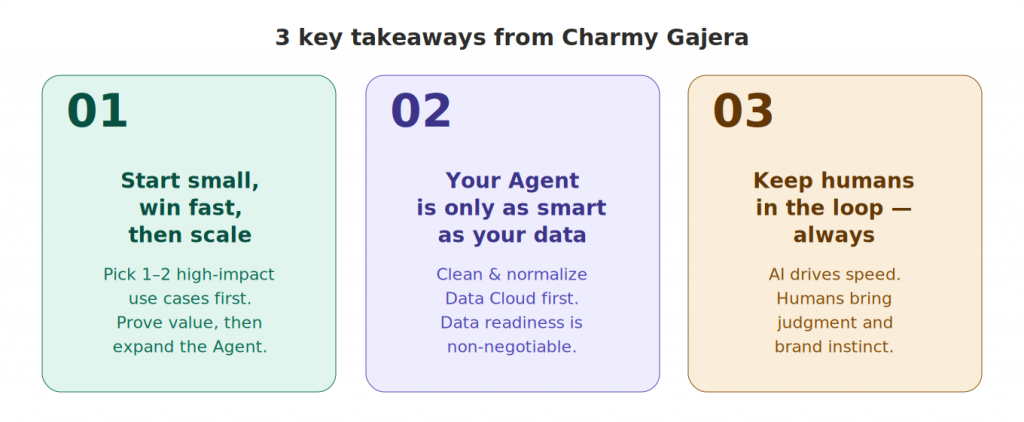
1. Start Small, Win Fast, Then Scale
Don’t try to automate everything on Day 1. Charmy’s advice is crystal clear — pick 1–2 high-impact use cases, prove the value, and then expand. Her Marketing Advisor Agent cut campaign prep from 2–3 hours to under 30 minutes. That’s the kind of quick win that earns you budget and buy-in for the next phase.
2. Your Agent is Only as Smart as Your Data
Garbage in, garbage out — and AI Agents are no exception. Before you even think about deploying Agentforce in your marketing stack, clean and normalize your data in Data Cloud. Charmy learned this the hard way so you don’t have to. Data readiness is not a nice-to-have; it’s the foundation of the entire implementation.
3. Keep Humans in the Loop — Always
Over-automation is a real risk, especially when brand voice and customer trust are on the line. Charmy’s biggest lesson from her second Agent build? Keep humans in the approval chain. AI drives speed and consistency; humans bring judgment and heart. The best implementations respect both.
A huge thank you to Charmy Gajera for her time, her openness, and her genuine passion for this space. The Salesforce community is stronger because of champions like her who show up, share the real stuff, and inspire the rest of us to level up. 🙌
Are you implementing Agentforce in your marketing operations? What use cases are you exploring? Drop a comment below or connect with me on LinkedIn — I’d love to hear what you’re building.
Until next time — keep maximizing. 💪