


😂 The Question That Changed My Career
Early in my career, I was a developer working across mainframe, J2EE, and web technologies. I loved building things. But there was one question that kept bothering me:
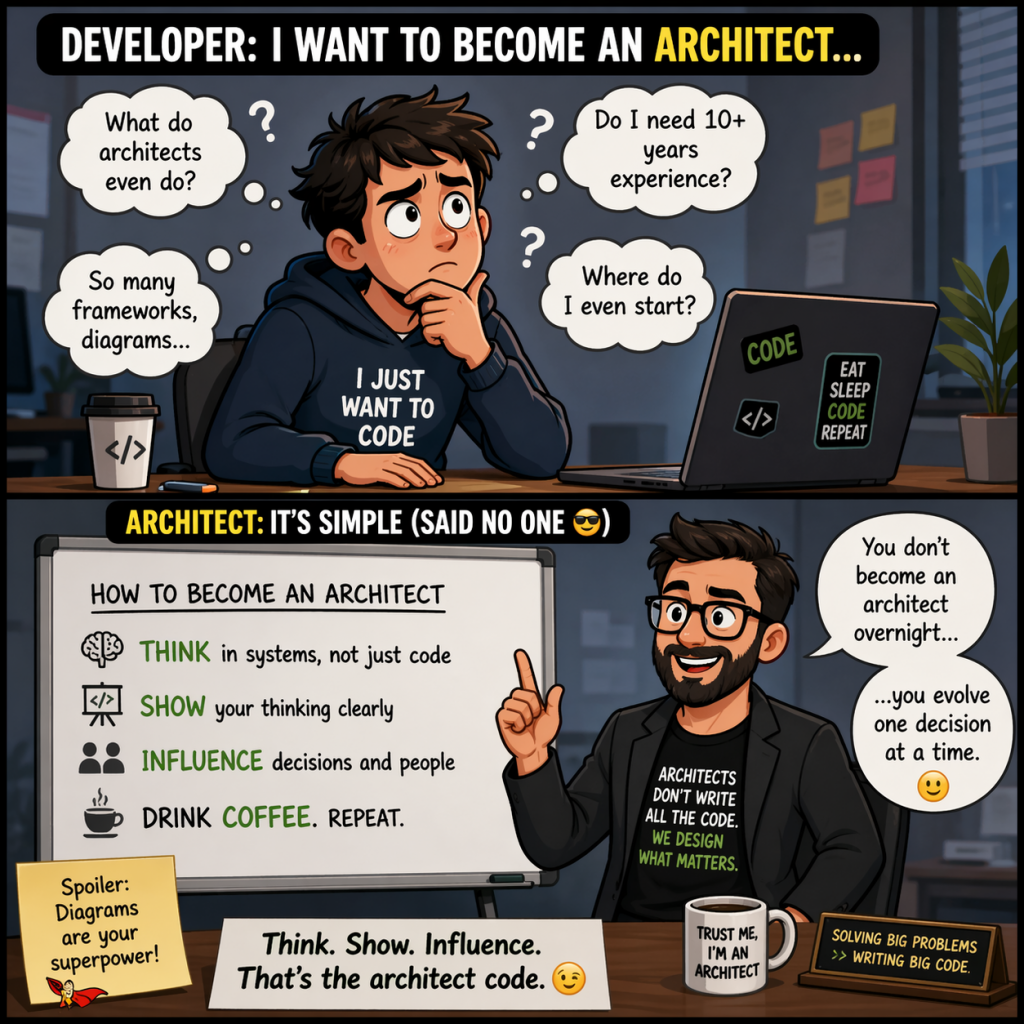
What do architects actually do differently? How do I become an architect?
They didn’t seem to code as much.
They didn’t dive into every detail.Yet… when they spoke, people listened.
When they presented solutions, decisions were made.That curiosity stayed with me for years—and eventually changed how I approached my career.

🧭 The Transition Nobody Explains Clearly
Fast forward to today, I get a lot of questions from developers:
“How do I become an architect?” Most answers focus on certifications, tools, and learning more technologies. But that’s not where it starts.
For me, the shift came down to three things:
👉 Think like an architect
👉 Show your thinking clearly
👉 Influence decisions and peopleThis didn’t happen overnight. It started with something much simpler:
🧠 1. THINK — How I Learned System-Level Thinking


When I started observing architects and reading frameworks like the Salesforce Well-Architected Framework, one thing became clear: It’s not just knowledge. It’s a mindset. And mindset is hard to teach.
So I took a different approach.
👉 I started building a set of questions to guide my thinking.
💡 The Questions That Changed Everything
Whenever I look at a solution today, I still ask these:
1. Systems Thinking
- How many systems are involved?
- Where do they overlap?
- What does the integration landscape look like?
2. Business & Process Thinking
- Does this actually meet the core requirement?
- How does it fit into the end-to-end business process?
- Is it easy for users?
3. Security Thinking
- Who has access to what?
- What are the risks around data and users?
- Are we exposing anything unintentionally?
4. Scalability & Cost Thinking
- Will this work when data volume grows?
- What happens to performance?
- What are the long-term costs and maintenance impacts?
5. Learning the Skills with Certifications
- Review the Salesforce architect Trailblazer pathway and decide on the application, system, or Solution architect route.
- Dedicate time to learning the skills and work on your certification.
- Follow the CTA architect path or alternate pathways to eventually achieve the pinnacle.
🔥 The Realization
Developers focus on building the solution.
Architects focus on understanding the impact of the solution.
🎯 2. SHOW — Turning Thinking Into Clear Solutions


Let me be honest. This was the toughest part of my journey. I’m an introvert—and presenting and whiteboarding did not come naturally to me.
😅 The Questions I Had
- When I go to a whiteboard, what kinds of boxes or diagrams should I draw to help the business user better understand my solution?
- How do I push myself out of my comfort zone?
- How do I present without sounding boring?
- How do I simplify for both technical and business users?
💡 What Actually Worked for me?
I didn’t magically become a great presenter. I built repetition:
- When I talk to business users about solutions, I tend to use whiteboards and sticky notes to present my thinking. Here is a small framework I use to present my solution thinking.
- Requirements ( Bullet points of User needs)
- Data Lens (object view, ERD)
- Technical Solution( Table with 2 options)
- Solution Decision( pros, cons, EAT( How easy, how adaptable, How secure Trusted)
- Considerations
- Presented solutions within my agile teams
- Took opportunities in user groups
- Learned storytelling
- Practiced consistently
🛠️ What Helped Me
Tools like:
- Lucidchart
- Microsoft Visio
And structured frameworks like:
- Salesforce Well-Architected Framework
⚡ Today’s Advantage: AI (Trust But Verify)
You can now:
- Generate diagrams
- Create solution decks
- Summarize ideas
- But you always need to verify the solution with the right reference.
🤝 3. INFLUENCE — The Skill That Actually Gets You Promoted


Thinking and presenting are important. But influence is what makes you an architect.
🚀 My Journey Into Influence
I started blogging in 2013—without any plan. I didn’t know:
- What to write
- Who would read it
I just shared what I was learning every week. Over time:
- I found an audience
- I started presenting
- I built credibility
💡 What I Learned
You don’t become an architect by title.
You become one by consistently sharing your thinking.
🎯 3 Key Takeaways
1. Build a Systems thinking mindset with better questions
Architecture begins when you evaluate systems, processes, security, and scalability.
2. Push through discomfort by learning the art of presentation
If you can’t present your ideas, who else can present for you?
3. Build trust through Influence before you get the magic title in your organization
Credibility comes from consistently sharing, presenting, and influencing.
🚀 Final Thought
Looking back, my transition didn’t happen because I learned more technology.
It happened because I changed:
- How I think
- How I communicate
- How I influence
If you’re a developer or admin, thinking about becoming an architect, I will be creating a blog series to help you transition to that role easily. Please feel free to email me at buyan@eigenx.com for further questions.